
YouTube Video Application in Mathematical Physics 1 Lecture: Effectiveness on Students' Conceptual Understanding
DOI:
https://doi.org/10.20415/iconphyedu.v1i1.76Keywords:
YouTube, Mathematical Physics, video learning, Conceptual understandingAbstract
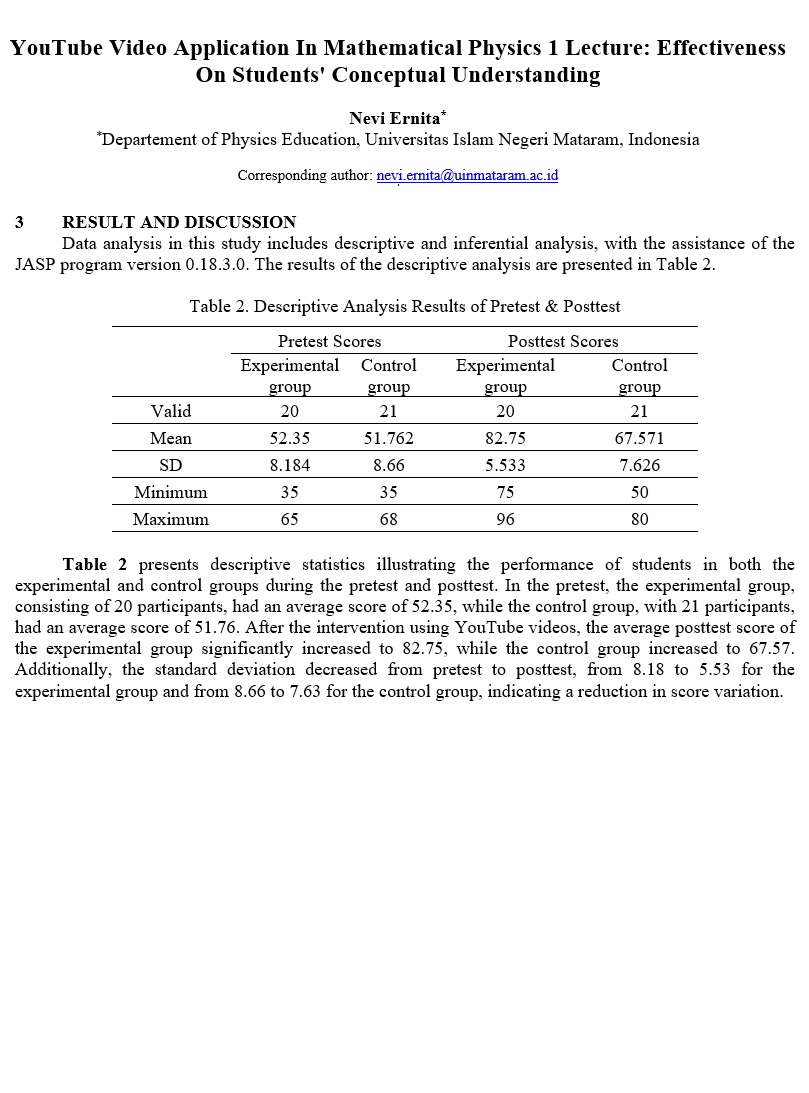
This study investigates the effectiveness of YouTube videos in enhancing students' conceptual understanding in a Mathematical Physics course. Mathematical Physics concepts, particularly Multiple Integrals, are often challenging for students due to their abstract nature. Thus, digital video-based learning is proposed to improve student comprehension. The study employs an experimental design with two groups: an experimental group using YouTube videos and a control group using conventional methods. The YouTube videos used in this study featured animated visual explanations, step-by-step problem-solving demonstrations, and real-world applications of Multiple Integrals. The intervention was conducted over five sessions, integrating structured video lessons with guided problem-solving activities. Data collection involved pretests and posttests to assess improvements in conceptual understanding. Statistical tests included normality, homogeneity, and t-tests. Results showed a significant improvement in the experimental group, with a posttest mean of 82.75 compared to the control group's 67.57. A t-test revealed an essential difference between the groups (p < 0.001), indicating that YouTube videos significantly contribute to students' understanding. These findings highlight the potential of digital media, particularly YouTube, in addressing conceptual difficulties in Mathematical Physics and fostering more engaging learning experiences. The study provides practical recommendations for integrating video-based learning into physics education to improve student outcomes.
Downloads
References
Addido, J., Burrows, A. C., & Slater, T. F. (2022). Addressing Pre-Service Teachers’ Misconceptions And Promoting Conceptual Understanding Through The Conceptual Change Model. Problems of Education in the 21st Century, 80(4), 499–515. https://doi.org/10.33225/pec/22.80.499
Akihary, W., Maruanaya, R. F., Lestuny, C., & Maruanaya, S. P. (2023). The YouTube-assisted discovery learning model: Improving students’ cognitive learning outcomes and critical thinking. Journal of Education and Learning (EduLearn), 17(4), 548–554. https://doi.org/10.11591/edulearn.v17i4.20851
Alzoubi, H., Karasneh, R., Irshaidat, S., Abuelhaija, Y., Abuorouq, S., Omeish, H., Daromar, S., Makhadmeh, N., Alqudah, M., Abuawwad, M. T., Taha, M. J. J., Baniamer, A., & Abu Serhan, H. (2023). Exploring the Use of YouTube as a Pathology Learning Tool and Its Relationship With Pathology Scores Among Medical Students: Cross-Sectional Study. JMIR Medical Education, 9, e45372. https://doi.org/10.2196/45372
Amin, U. U., Nordin, N., & Hasbullah, S. A. (2021). ASSESSMENT OF CULINARY CLASS DEMONSTRATION METHODS ON STUDENTS’ PERFORMANCE: VIDEO VERSUS LIVE STREAMING. Journal of Event, Tourism and Hospitality Studies (JETH), Number 1, 71–94. https://doi.org/10.32890/jeth2021.1.4
Anisa, Y., Hafiz, M., & Azmi, F. (2023). The Potential of YouTube as a Source of Mathematics Learning Education. Asian Research Journal of Mathematics, 19(12), 1–8. https://doi.org/10.9734/arjom/2023/v19i12767
Dunnsiri, T., Kawashita, T., Lee, S., Monga, A., & Woo, B. (2020). Assessing youtube as an educational tool for shingles: cross-sectional study. Jmir Dermatology, 3(1), e20338. https://doi.org/10.2196/20338
Effendi, Moh. M., Putri Rosyadi, A. A., Fatihah, S. M., Purnomo, H., & Abdullah, A. H. (2024). Web-Based Window Shopping: A Learning Model in High School’s Mathematics Curriculum. TEM Journal, 213–220. https://doi.org/10.18421/TEM131-22
Fansury, A. H., Januarty, R., Rahman, A. W., & Syawal. (2020). Digital Content for Millennial Generations: Teaching the English Foreign Language Learner on COVID-19 Pandemic. Journal of Southwest Jiaotong University, 55(3). https://doi.org/10.35741/issn.0258-2724.55.3.40
Fayasari, A., Sandra, S., Syahadah, M. M., Wulandari, D., & Akbar, R. (2023). Pentingnya Gizi Seimbang pada Siswa di SMA Negeri 87 Jakarta. Kolaborasi: Jurnal Pengabdian Masyarakat, 3(1), 8–15. https://doi.org/10.56359/kolaborasi.v3i1.177
Flores, M. M., Hinton, V. M., & Blanton, E. N. (2023). Remote Teaching of Multidigit Multiplication for Students With Learning Disabilities. Learning Disability Quarterly, 46(4), 292–305. https://doi.org/10.1177/07319487221103838
Gemechu, E., Mogiso, A., Hussein, Y., & Adugna, G. (2021). Students' conception on multiple integrals of a function of several variables: a case of adama science and technology university. American Journal of Applied Mathematics, 9(1), 10. https://doi.org/10.11648/j.ajam.20210901.12
Handoko, A., Anggoro, B. S., Intan, S. R. I. R., & Marzuki, M. (2022). Trello : Pengaruh Project Based Learning (PJBL) Terhadap Kemampuan Berpikir Kreatif Peserta Didik. Diklabio: Jurnal Pendidikan Dan Pembelajaran Biologi, 173–180. https://doi.org/10.33369/diklabio.6.2.173-180
Hu, W. (2024). A case study of incorporating digital technologies into audio-visual-oral English teaching in the context of digital humanities. SHS Web of Conferences, 181, 04041. https://doi.org/10.1051/shsconf/202418104041
Humaidi, H., Qohar, A., & Rahardjo, S. (2021). Respon Siswa terhadap Penggunaan Video Youtube sebagai Media Pembelajaran Daring Matematika. JIPM (Jurnal Ilmiah Pendidikan Matematika), 10(2), 153. https://doi.org/10.25273/jipm.v10i2.9108
Husnawati, F., & Rakhmawati, A. (2024). The Influence of Blended Learning Methods in Learning Physics: A Literature Review. Jurnal Pendidikan Dan Ilmu Fisika, 4(1), 10. https://doi.org/10.52434/jpif.v4i1.3385
Insorio, A. O., & Macandog, D. M. (2022). YouTube Video Playlist as Mathematics Supplementary Learning Material for Blended Learning. European Journal of Interactive Multimedia and Education, 3(2), e02212. https://doi.org/10.30935/ejimed/12490
Jeremy Kilpatrick, Jane Swafford, & Bradford Findell. (2001). Adding It Up: Helping Children Learn Mathematics (N. R. C. Mathematics Learning Study Committee, Ed.). National Academy of Sciences.
Johnrey R. Libit, P., G. Madrilejo, G., & G. Borja, L. (2023). SHS Students’ Perception Towards the Use of YouTube as an Alternative Instruction in Physical Science. International Journal of Research Publications, 127(1). https://doi.org/10.47119/IJRP1001271620235047
Khan, R., Cobern, W. W., Adams, B., & Amadeu Filho, J. R. (2019, January 21). STEM Students’ Voluntary Use of YouTube to Learn Science Topics Taught in High School and/or College. 2018 Physics Education Research Conference Proceedings. https://doi.org/10.1119/perc.2018.pr.Khan
Khaidir, C., Yuberta, K., & Wahid, R. (2024). Students' mathematical spatial ability in integral calculus lectures. IJATSS, 2(4), 559-568. https://doi.org/10.59890/ijatss.v2i4.1757
Kurniawan, A., Pattiasina, P., Rahman, A., Lestari, N., & Haddar, G. (2024). Utilization of youtube as a problem solving-based learning media. TECHNOVATE, 1(2), 62-68. https://doi.org/10.52432/technovate.1.2.2024.62-68
Laelasari, I., & Wakhidah, N. (2023). Conceptual understanding and analysis conceptual difficulties of nervous system: from the perspective of pre-service biology teachers. THABIEA : JOURNAL OF NATURAL SCIENCE TEACHING, 6(2), 182. https://doi.org/10.21043/thabiea.v6i2.16690
Lathipatud Durriyah, T., & Zuhdi, M. (2018). Digital Literacy With EFL Student Teachers: Exploring Indonesian Student Teachers’ Initial Perception About Integrating Digital Technologies Into a Teaching Unit. International Journal of Education and Literacy Studies, 6(3), 53. https://doi.org/10.7575/aiac.ijels.v.6n.3p.53
LeGresley, S. E., Delgado, J. A., Bruner, C. R., Murray, M. J., & Fischer, C. J. (2019). Calculus-enhanced energy-first curriculum for introductory physics improves student performance locally and in downstream courses. Physical Review Physics Education Research, 15(2), 020126. https://doi.org/10.1103/PhysRevPhysEducRes.15.020126
Listiantomo, D. P., & Dwikoranto. (2023). Implementasi Model Inkuiri Terbimbing Berbantuan Virtual Lab Untuk Meningkatkan Kemampuan Berpikir Kritis Peserta Didik Kelas XI Pada Materi Gelombang Cahaya. PENDIPA Journal of Science Education, 7(2), 274–281. https://doi.org/10.33369/pendipa.7.2.274-281
Mangangantung, J. M., Wijaya, T. T., Putra, R. A., & Hermita, N. (2021). Pre-service Elementary Teachers’ Mental Model on Heat Transfer Concept as the Effect of Applying CDOI Model Integrated MIKiR Approach. AL-ISHLAH: Jurnal Pendidikan, 13(3), 1868–1876. https://doi.org/10.35445/alishlah.v13i3.823
Maziriri, E. T., Gapa, P., & Chuchu, T. (2020). Student Perceptions Towards the use of YouTube as An Educational Tool for Learning and Tutorials. International Journal of Instruction, 13(2), 119–138. https://doi.org/10.29333/iji.2020.1329a
Mohammed, I. A., & Ogar, S. I. (2023). Exploring the potential of YouTube videos towards enhancing achievement and retention of undergraduate students in environmental education. European Journal of Interactive Multimedia and Education, 4(1), e02302. https://doi.org/10.30935/ejimed/13190
Nurwahida. (2024). Penggunaan Whatsapp dan Youtube dalam Pmebelajaran Matematika. Journal of Social and Scientific Education, 51–57. https://doi.org/10.58230/josse.v1i2.120
Pérez-Garrido, A. (2024). Integrating Differential Forms and Vector Fields: Powerful Tools for Classical Vector Calculus.
Rani, P. R., Lestari, A., Mutmainah, F., Ishak, K. A., Delima, R., Siregar, P. S., & Marta, E. (2021). Pengaruh Metode PJBL Terhadap Hasil Belajar Matematika di Sekolah Dasar. Journal for Lesson and Learning Studies, 4(2), 264–270. https://doi.org/10.23887/jlls.v4i2.34570
Rohmah, R. N., Utomo, D. P., & Zukhrufurrohmah, Z. (2020). The Effectiveness of Implementation Warmer Apperception to Construct the Conceptual Understanding on the Learning Material of Vector. Mathematics Education Journal, 3(2), 159. https://doi.org/10.22219/mej.v3i2.11073
Russo, J., Bobis, J., Downton, A., Livy, S., & Sullivan, P. (2021). Primary Teacher Attitudes towards Productive Struggle in Mathematics in Remote Learning versus Classroom-Based Settings. Education Sciences, 11(2), 35. https://doi.org/10.3390/educsci11020035
Saleh, A. M., & Ahmed Althaqafi, A. S. (2022). The Effect of Using Educational Games as a Tool in Teaching English Vocabulary to Arab Young Children: A Quasi-Experimental Study in a Kindergarten School in Saudi Arabia. SAGE Open, 12(1), 215824402210798. https://doi.org/10.1177/21582440221079806
Saputra, H., & Mustika, D. (2022). Analysis the Conceptual Understanding Level and Understanding Model of Pre-Service Physics Teacher. Jurnal Penelitian Pendidikan IPA, 8(5), 2367–2372. https://doi.org/10.29303/jppipa.v8i5.2246
Sartipa, D., Munisah, E., & Kuning, D. (2022). Youtube as a teaching media to enggage students’ interest iin learning speaking of english language learners at universitas muhammadiyah kotabumi. E-Journal of Linguistics, 16(2), 237. https://doi.org/10.24843/e-jl.2022.v16.i02.p09
Sugiyono. (2017). Metode Penelitian Pendidikan. Pendekatan Kuantitatif, Kualitatif, dan R&D. Alfabeta.
Sukarelawan, Moh. I., Indratno, T. K., Widodo, W., Dwijananti, P., Hikmah, F. N., & Abdullah, N. S. Y. (2024). What do my students need? Deep analysis of student’s individual cognitive ability using person diagnostic map. Momentum: Physics Education Journal, 8(2), 217–229. https://doi.org/10.21067/mpej.v8i2.9900
Syafiq, A. N., Rahmawati, A., Anwari, A., & Oktaviana, T. (2021). Increasing Speaking Skill through YouTube Video as English Learning Material during Online Learning in Pandemic Covid-19. Elsya : Journal of English Language Studies, 3(1), 50–55. https://doi.org/10.31849/elsya.v3i1.6206
Wahyuni, W., Helmi, H., Irmawati, I., & Fitri, F. (2024). Efektivitas Penggunaan YouTube Sebagai Media Pembelajaran Matematika. Jurnal Konatif: Jurnal Ilmiah Pendidikan, 2(1), 1–14. https://doi.org/10.62203/jkjip.v2i1.21
White Brahmia, S., Olsho, A., Smith, T. I., & Boudreaux, A. (2020). Framework for the natures of negativity in introductory physics. Physical Review Physics Education Research, 16(1), 010120. https://doi.org/10.1103/PhysRevPhysEducRes.16.010120
Downloads
Published
How to Cite
Issue
Section
License
Copyright (c) 2025 Proceeding of International Conference on Physics and Physics Education

This work is licensed under a Creative Commons Attribution-NonCommercial-ShareAlike 4.0 International License.