EFFECTIVENESS OF THE SAVAR LEARNING MODEL BASED ON MIXED REALITY IN STRENGTHENING RELIGIOUS MODERATION TO STUDENT
DOI:
https://doi.org/10.20415/iconphyedu.v1i1.73Keywords:
SAVAR Learning Model, Mixed Reality, Religious Moderation, Tolerance, Educational TechnologyAbstract
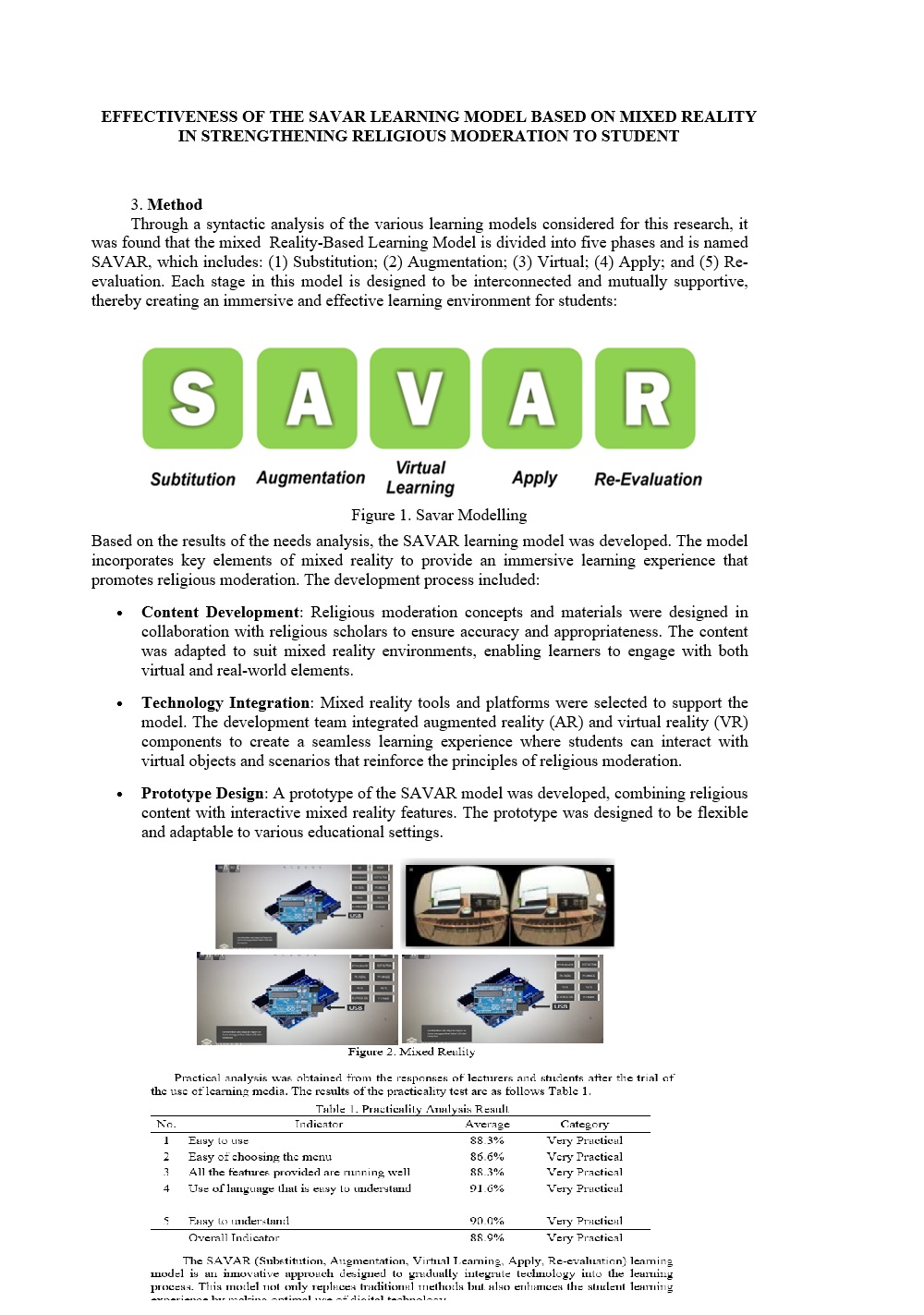
The effectiveness of educational models plays a crucial role in shaping students' perspectives and behaviors. In recent years, the integration of mixed reality (MR) into learning environments has shown significant promise in enhancing student engagement and understanding by blending the physical and digital worlds. One such innovative approach is the SAVAR (learning model, which promotes active student participation and deeper understanding through immersive, hands-on learning experiences. This research aims to analyze the effectiveness of the SAVAR (Substitution, Augmented, Virtual Learning, Apply, Reevaluation) learning model, which incorporates mixed reality technology to foster religious moderation among students. By combining the SAVAR learning model with mixed reality technologies, students are presented with interactive scenarios that enable them to engage with and reflect on real-world issues of religious diversity and harmony. Conducted at Politeknik Bosowa Makassar, the study involved 30 students as participants, utilizing a mixed-method approach to gather both quantitative and qualitative data. The SAVAR model seeks to enhance students' understanding and appreciation of religious diversity by creating an immersive, interactive learning environment that integrates visual, auditory, and kinesthetic elements. The average practicality of mixed reality learning media is 88.9% with “very practical” category. Additionally, qualitative feedback from students indicated increased engagement and a positive attitude toward diversity. These results indicate that the integration of mixed reality into the SAVAR model has a significant positive impact on promoting tolerance and developing a more inclusive educational setting, thereby supporting the broader goal of social harmony.
Downloads
References
Afandi, M. (2013). Model dan Metode Pembelajaran di Sekolah.
Anderson, P. (2022). The Metaverse: Exploring the Virtual World's Educational Potential. Journal of Educational Technology, 18(3), 45-59.
Alkhamisi, O. (2013). Rise of Augmented Reality: Current and Future Application Areas. International Journal of Internet and Distributed Systems, 1(1), 25–34.
Anggeraini, Y. (2019). Literasi Digital: Dampak dan Tantangan dalam Pembelajaran Bahasa. SEMINAR NASIONAL PASCASARJANA 2019, 386–389.
Ayu, L. T. (2014). Pengaruh Metode Pembelajaran Diskusi Berbasis Lesson Study Terhadap Aktivitas dan Hasil Belajar Biologi Dengan Menggunakan Assessment Portofolio (Siswa Kelas X Semester Genap SMA Negeri Kalisat Tahun Ajaran 2012/2013). Pancaran, 3(1), 111–120.
Syafar,A.M. , M. Agung, W. Wisanty, Haswah, and J. N. Amanda (2023), “360- Degree Panoramic Visualization in Archaeological Documentation: An Interactive Learning Tool,”, pp. 101–109. doi: 10.2991/978-2-38476-084- 8_15.
Syafar, A. M. (2021). Filsafat dan Rekonstruksi Teori Mata Kuliah Matematika Komputer pada Learning Centre Area (LENTERA) Virtual Class. ALL Grafika Makassar.
Syafar, A. M., Gani, H. A., & Agung, M. (2023). Development Of A Learning Model For Industrial Control Engineering Courses With AR Dan VR technology. Proceedings of the 3rd International Conference on Social and Islamic Studies, 289–294.
Syafar, A. M., Hasrul, M. H., Nurhidayat, A. M., & Akhiruddin. (2021). Aplikasi Pengenalan Buku Mata Kuliah Teknologi Informasi Dengan Teknologi Augmented Reality Berbasis Android. Jurnal Instek, 6(2), 245–253
Downloads
Published
How to Cite
Issue
Section
License
Copyright (c) 2025 Proceeding of International Conference on Physics and Physics Education

This work is licensed under a Creative Commons Attribution-NonCommercial-ShareAlike 4.0 International License.