
Peer Instruction and PhET Simulations: Strengthening Students’ Understanding of Motion
DOI:
https://doi.org/10.20415/iconphyedu.v1i1.71Keywords:
Acceleration, Motion, PhET Simulation, Peer Instruction, Position, VelocityAbstract
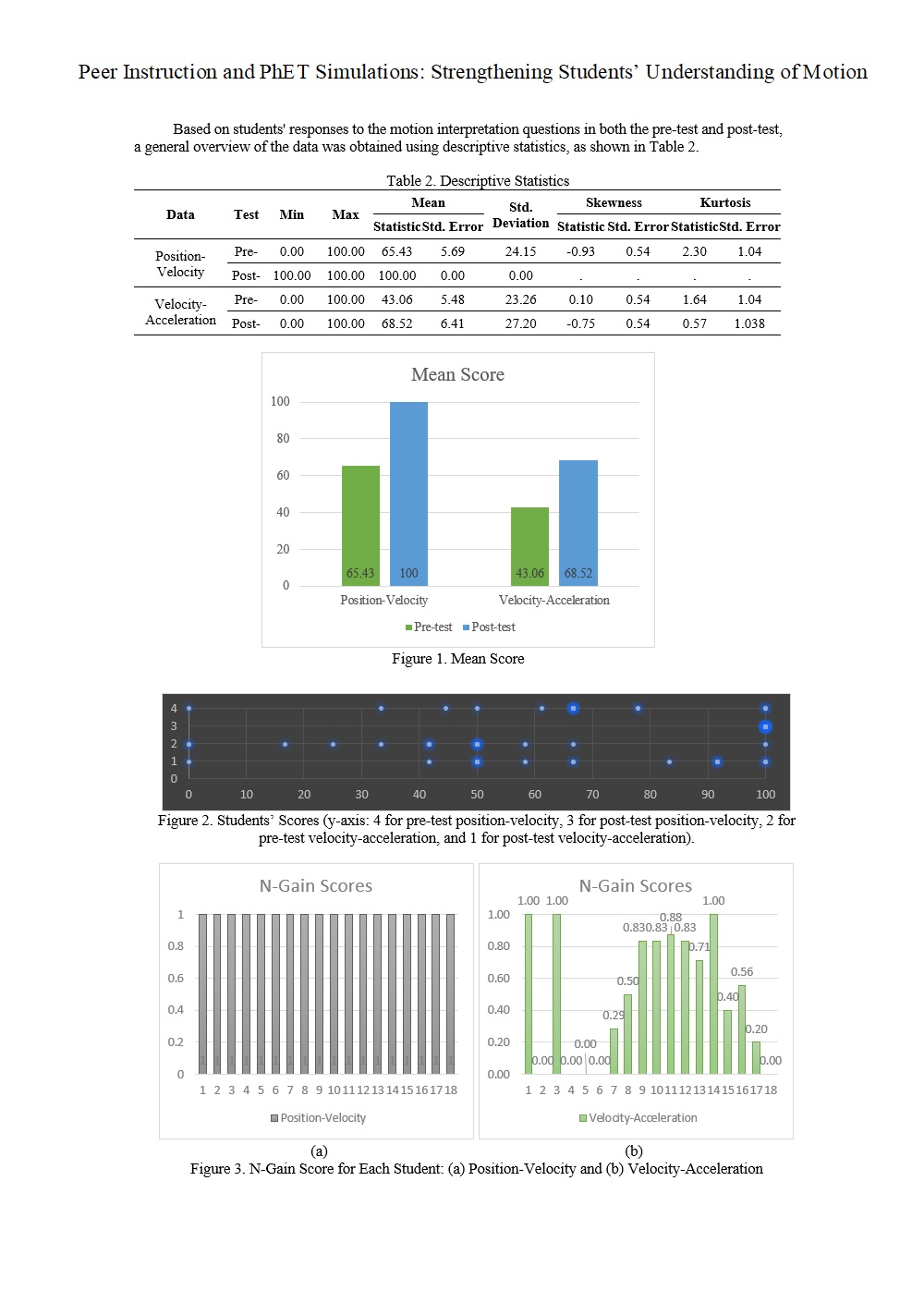
This study investigates the effectiveness of integrating peer instruction with PhET simulations in enhancing students' interpretation and understanding of motion concepts, specifically position, velocity, and acceleration. The primary goal was to assess whether this combined approach could improve conceptual comprehension and reduce misconceptions in kinematics. The study was conducted with 18 students enrolled in a basic physics course, using a pre-experimental one-group pre-test and post-test design. Data was collected through conceptual tests administered before and after instruction. Data analysis included descriptive statistics and N-Gain score calculations to measure learning improvement. The results revealed a significant enhancement in students’ interpretation of position-velocity relationships, with an N-Gain score in the high category (1.0). However, misconceptions regarding the velocity-acceleration relationship persisted, as reflected by a medium N-Gain score (0.45). Common misconceptions included the belief that acceleration determines motion direction and that positive acceleration always increases speed. The combination of peer instruction and PhET simulations proved effective in addressing position-velocity misconceptions, fostering student engagement and conceptual learning. However, persistent challenges in velocity-acceleration understanding suggest the need for additional instructional strategies, such as emphasizing vector concepts and graphical analysis. Given the study’s small sample size, future research should explore broader implementations, investigate long-term retention, and examine alternative factors influencing conceptual change. This study contributes to physics education research by highlighting effective strategies for improving conceptual understanding and addressing misconceptions in kinematics.
Downloads
References
Aprilia, S. L., Pranata, O. D., & Haryanto, T. (2023). Analisis Tingkat Familiaritas Siswa Terhadap Istilah Sains dan Biologi. Bioedusains:Jurnal Pendidikan Biologi Dan Sains, 6(2), 580–591.
Barniol, P., & Zavala, G. (2014). Force, velocity, and work: The effects of different contexts on students’ understanding of vector concepts using isomorphic problems. Physical Review Special Topics - Physics Education Research, 10(2), 020115. https://doi.org/10.1103/PhysRevSTPER.10.020115
Beichner, R. J. (1994). Testing student interpretation of kinematics graphs. American Journal of Physics, 62(8), 750–762. https://doi.org/10.1119/1.17449
Crouch, C. H., & Mazur, E. (2001). Peer Instruction: Ten years of experience and results. American Journal of Physics, 69(9), 970–977. https://doi.org/10.1119/1.1374249
Gjerde, V., & Hagane, S. (2024). Enhancing peer instruction in physics: Understanding cognitive processes and refining rules. Physical Review Physics Education Research, 20(1), 10134. https://doi.org/10.1103/PhysRevPhysEducRes.20.010134
Gok, T. (2012). The effects of peer instruction on student’s conceptual learning and motivation. Asia-Pacific Forum on Science Learning and Teaching, 13(1), 1–17.
Hake, R. R. (1998). Interactive-engagement versus traditional methods: A six-thousand- student survey of mechanics test data for introductory physics courses. American Journal of Physics, 66(1), 64–74. https://pubs.aip.org/aapt/ajp/article-abstract/66/1/64/1055076/Interactive-engagement-versus-traditional-methods
Hestenes, D., Wells, M., & Swackhamer, G. (1992). Force concept inventory. The Physics Teacher, 30(3), 141–158. https://doi.org/10.1119/1.2343497
Körhasan, N. D. (2021). Investigation of the Interaction of Students’ Mental Models with Peer Instructional Elements in an Undergraduate Physics Course. Science Education International, 32(3), 220–230. https://doi.org/10.33828/sei.v32.i3.5
Lasry, N., Mazur, E., & Watkins, J. (2008). Peer instruction: From Harvard to the two-year college. American Journal of Physics, 76(11), 1066–1069. https://doi.org/10.1119/1.2978182
Lemmer, M. (2013). Nature, Cause and Effect of Students’ Intuitive Conceptions Regarding Changes in Velocity. International Journal of Science Education, 35(2), 239–261. https://doi.org/10.1080/09500693.2011.647110
Lichtenberger, A., Wagner, C., Hofer, S. I., Stern, E., & Vaterlaus, A. (2017). Validation and structural analysis of the kinematics concept test. Physical Review Physics Education Research, 13(1), 1–13. https://doi.org/10.1103/PhysRevPhysEducRes.13.010115
Lin, J., Xing, Y., Hu, Y., Zhang, J., Bao, L., Luo, K., Yu, K., & Xiao, Y. (2023). Inhibitory control involvement in overcoming the position-velocity indiscrimination misconception among college physics majors. Physical Review Physics Education Research, 19(1), 10112. https://doi.org/10.1103/PhysRevPhysEducRes.19.010112
Mazur, E. (2014). Peer Instruction: A User’s Manual (Person New). Pearson Education.
McDermott, L. C., Rosenquist, M. L., & van Zee, E. H. (1987). Student difficulties in connecting graphs and physics: Examples from kinematics. American Journal of Physics, 55(6), 503–513. https://doi.org/10.1119/1.15104
Motlhabane, A. (2016). Learner’s alternative and misconceptions in physics: A phenomenographic study. Journal of Baltic Science Education, 15(4), 424–440. https://doi.org/10.33225/jbse/16.15.424
Nadelson, L. S., Heddy, B. C., Jones, S., Taasoobshirazi, G., & Johnson, M. (2018). Conceptual change in science teaching and learning: Introducing the dynamic model of conceptual change. International Journal of Educational Psychology, 7(2), 151–195. https://doi.org/10.17583/ijep.2018.3349
Potvin, P., Nenciovici, L., Malenfant-Robichaud, G., Thibault, F., Sy, O., Mahhou, M. A., Bernard, A., Allaire-Duquette, G., Blanchette Sarrasin, J., Brault Foisy, L. M., Brouillette, N., St-Aubin, A. A., Charland, P., Masson, S., Riopel, M., Tsai, C. C., Bélanger, M., & Chastenay, P. (2020). Models of conceptual change in science learning: establishing an exhaustive inventory based on support given by articles published in major journals. Studies in Science Education, 56(2), 157–211. https://doi.org/10.1080/03057267.2020.1744796
Pranata, O. D. (2023a). Enhancing Conceptual Understanding and Concept Acquisition of Gravitational Force through Guided Inquiry Utilizing PhET Simulation. Saintek: Jurnal Sains Dan Teknologi, 15(1), 44–52. https://doi.org/10.31958/js.v15i1.9191
Pranata, O. D. (2023b). Physics Education Technology (PhET) as Confirmatory Tools in Learning Physics. Jurnal Riset Fisika Edukasi Dan Sains, 10(1), 29–35. https://doi.org/10.22202/jrfes.2023.v10i1.6815
Pranata, O. D. (2024a). Peer Instruction Using PhET Integrated with Inquiry-based Learning in Kinematics Physics Learning. Jurnal Ilmiah Pendidikan Fisika Al-Biruni, 13(2), 155–174. https://doi.org/10.24042/jipfalbiruni.v13i2.19299
Pranata, O. D. (2024b). Students’ understanding of vector operations : With and without physics education technology simulation. Journal of Mathematics and Science Teacher, 4(3), 1–8. https://doi.org/https://doi.org/10.29333/mathsciteacher/14633
Pranata, O. D. (2024c). Physics education technology (PhET) as a game-based learning tool: A quasi-experimental study. Pedagogical Research, 9(4), em0221. https://doi.org/10.29333/pr/15154
Pranata, O. D., & Seprianto, S. (2023). Pemahaman Konsep Siswa Melalui Skema Blended learning Menggunakan Lembar Kerja Berbasis Simulasi. Karst : Jurnal Pendidikan Fisika Dan Terapannya, 6(1), 8–17. https://doi.org/https://doi.org/10.46918/karst.v6i1.1724
Pranata, O. D., Seprianto, S., Adelia, I., Darwata, S. R., & Noperta, N. (2022). Science Outreach at Madrasa Menggunakan Simulasi PhET (Physics Education Technology). RANGGUK: Jurnal Pengabdian Kepada Masyarakat, 02(02), 1–9.
Riendeau, D. (2014). The languages of physics education. The Physics Teacher, 52(4), 251–252. https://doi.org/10.1119/1.4868950
Shaffer, P. S., & McDermott, L. C. (2005). A research-based approach to improving student understanding of the vector nature of kinematical concepts. American Journal of Physics, 73(10), 921–931. https://doi.org/10.1119/1.2000976
Trowbridge, D. E., & McDermott, L. C. (1980). Investigation of student understanding of the concept of velocity in one dimension. American Journal of Physics, 48(12), 1020–1028. https://doi.org/10.1119/1.12298
Wells, J., Henderson, R., Traxler, A., Miller, P., & Stewart, J. (2020). Exploring the structure of misconceptions in the force and motion conceptual evaluation with modified module analysis. Physical Review Physics Education Research, 16(1), 10121. https://doi.org/10.1103/PhysRevPhysEducRes.16.010121
Wieman, C. E., Adams, W. K., Loeblein, P., & Perkins, K. K. (2010). Teaching Physics Using PhET Simulations. The Physics Teacher, 48(4), 225–227. https://doi.org/10.1119/1.3361987
Wieman, C. E., & Perkins, K. K. (2006). A powerful tool for teaching science. Nature Physics, 2(5), 290–292. https://doi.org/10.1038/nphys283
Winter, J. de, & Hardman, M. (2020). Teaching Secondary Physics. In J. de Winter & M. Hardman (Eds.), Teaching Secondary Science (3rd ed.). https://books.google.com.my/books?id=ZSoryQEACAAJ
Zavala, G., Tejeda, S., Barniol, P., & Beichner, R. J. (2017). Modifying the test of understanding graphs in kinematics. Physical Review Physics Education Research, 13(2), 1–16. https://doi.org/10.1103/PhysRevPhysEducRes.13.020111
Zhu, G., & Singh, C. (2012). Improving students’ understanding of quantum measurement. II. Development of research-based learning tools. Physical Review Special Topics - Physics Education Research, 8(1), 1–13. https://doi.org/10.1103/PhysRevSTPER.8.010118
Downloads
Published
How to Cite
Issue
Section
License
Copyright (c) 2025 Proceeding of International Conference on Physics and Physics Education

This work is licensed under a Creative Commons Attribution-NonCommercial-ShareAlike 4.0 International License.