
Development of Guided Inquiry-Based Learning Tools to Train Early Childhood Critical Thinking Skills
DOI:
https://doi.org/10.20415/iconphyedu.v1i1.69Keywords:
Learning Tools, guided inquiry, critical thinking skills, early childhoodAbstract
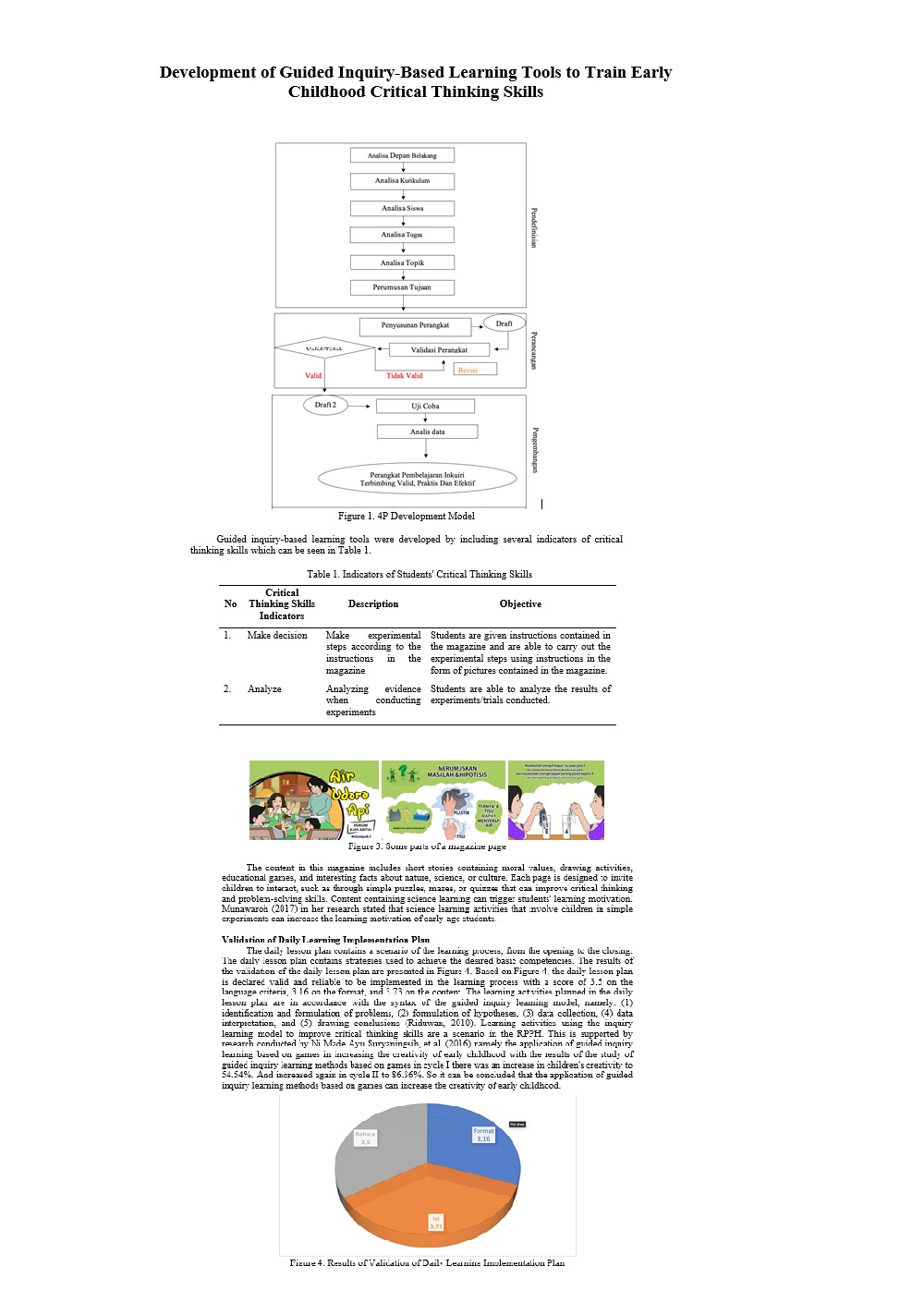
This study aims to develop a guided inquiry-based learning device to train critical thinking skills in early childhood. The learning devices developed are in the form of daily learning plans (RPPH), magazines, and critical thinking skills observation sheets. This learning device was developed using the Four-D development model, namely design, define, develop, and disseminate. The learning devices that have been prepared were then validated by two validators with results showing Very Valid. The magazine obtained an average validation value of 3.59. RPPH obtained a validation value of 3.64. While the critical thinking skills observation sheet obtained a validation value of 3.55. Data collection techniques in this study used observation, expert validation, and documentation. Observation was used to collect data on students' critical thinking skills, validation was used to collect data related to the value of the developed learning device, and documentation was used to collect information needed in this study. Based on the results shown in this study, it can be concluded that the guided inquiry-based learning device developed is valid and effective for training critical thinking skills in early childhood which is one of the significant skills that children must have from an early age.
Downloads
References
Ennis, R.H. (1991). Critical Thinking: A Streamlined Conception. Teaching Philosopy. University Of Lillionis.
Farida Rohayani. (2013) Model Pembelajaran Inkuiri untuk Pendidikan Anak Usia Dini. Golden Age Jurnal Ilmiah Tumbuh Kembang Anak Usia Dini. Vol. 3 No. 1 Maret.
Hadi, S. A. U., Azmi, K., & Rosida, S. A. (2021). Melatih keterampilan berpikir kritis anak usia dini melalui penerapan model pembelajaran inkuiri terbimbing. Schemata: Jurnal Pasca Sarjana IAIN Mataram, 10(2), 151-162.
Ibrahim, M. (2002). Pengembangan Perangkat Pembelajaran. Modul-Bio-C-06 Direktorat Sekolah Lanjutan Tingkat Pertama Direktorat Jenderal Pendidikan Dasar dan Menengah Departemen Pendidikan Nasional.
Kumisi, R. (2019). UPAYA MENINGKATKAN KOMPETENSI GURU DALAM MENYUSUN RENCANA PROGRAM PEMBELAJARAN HARIAN MELALUI BIMBINGAN BERKELANJUTAN DI TK NEGERI PEMBINA KECAMATAN KOTA BARAT KOTA GORONTALO. pdf. Ideas: Jurnal Pendidikan, Sosial, dan Budaya, 5(2), 237-254.
Latifah, N., Ashari, A., & Kurniawan, E. S. (2020). Pengembangan e-modul fisika untuk meningkatkan kemampuan berpikir kritis peserta didik. Jurnal Inovasi Pendidikan Sains (JIPS), 1(1), 1-7.
Munawaroh, H. (2017). Pelaksanaan pembelajaran sains anak di RA perwanida wonosobo. SPEKTRA: Jurnal Kajian Pendidikan Sains, 3(2), 169-176.
Ratumanan, T.G. dan Laurens. (2006). Evaluasi Hasil Belajar yang Relevan dengan Kurikulum Berbasis Kompetensi. Surabaya: Unesa UneversityPress.
Reswari, A. (2021). Efektivitas Pembelajaran Berbasis Steam Terhadap Kemampuan Berpikir Kritis (Hots) Anak Usia 5-6 Tahun. JCE (Journal of Childhood Education), 5(1), 1-10.
Riduwan. (2010). Skala Pengukuran Variabel-Variabel Penelitian. Bandung:
Alfabeta.
Umbaryati, U. (2016, February). Pentingnya LKPD pada pendekatan scientific pembelajaran matematika. In PRISMA, prosiding seminar nasional matematika (pp. 217-225).
Yunita, H., Meilanie, S. M., & Fahrurrozi, F. (2019). Meningkatkan Kemampuan Berpikir Kritis melalui Pendekatan Saintifik. Jurnal Obsesi: Jurnal Pendidikan Anak Usia Dini, 3(2), 425-432.
Downloads
Published
How to Cite
Issue
Section
License
Copyright (c) 2025 Proceeding of International Conference on Physics and Physics Education

This work is licensed under a Creative Commons Attribution-NonCommercial-ShareAlike 4.0 International License.