
Psychological Review in Problem-Based Learning Model on Physics Learning Outcomes Of Class X Students at MA Rahmatullah Al-Hasan Nw Kekait West Lombok
DOI:
https://doi.org/10.20415/iconphyedu.v1i1.120Keywords:
Learning Outcomes, Problem-Based Learning, Psychological TheoryAbstract
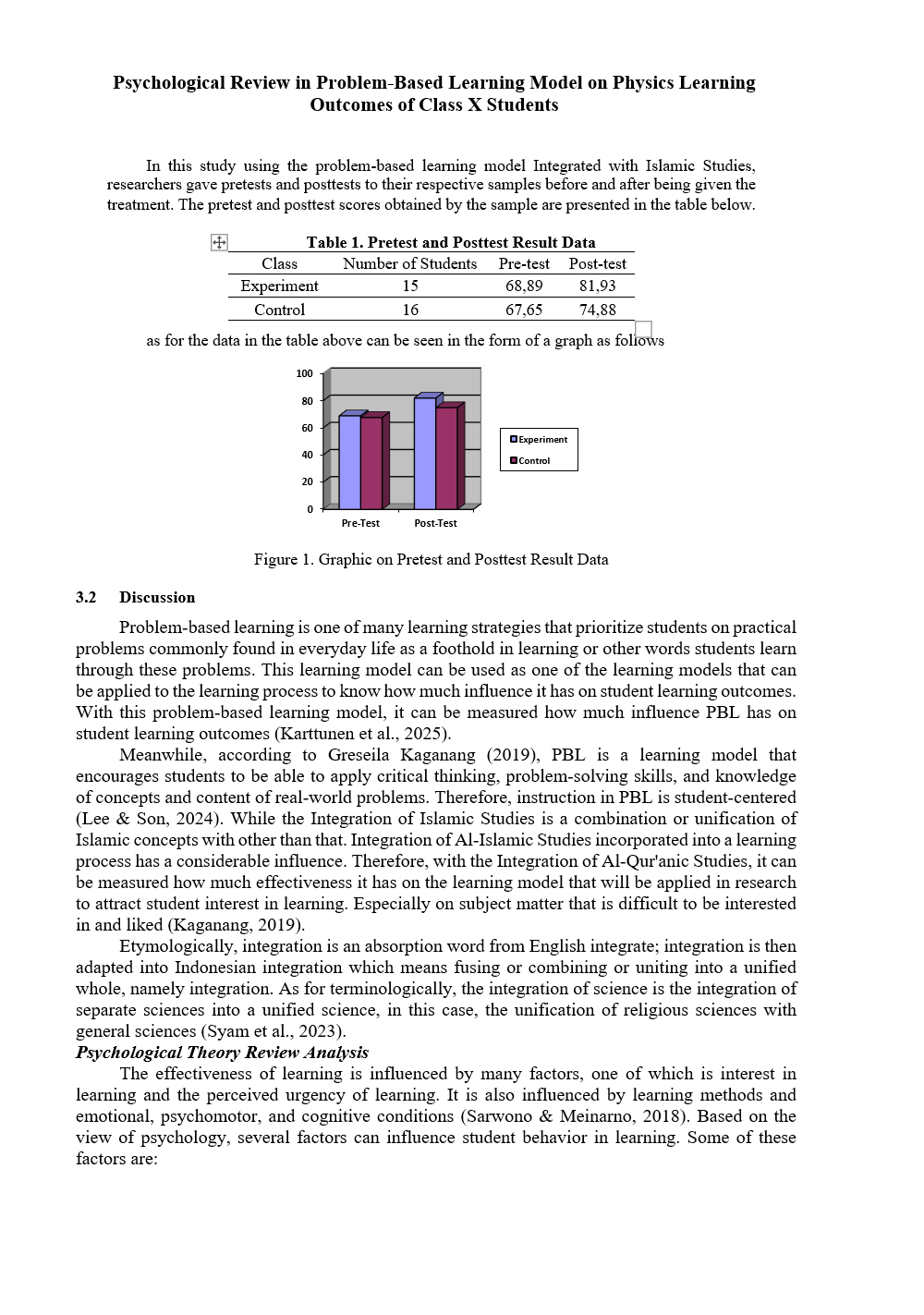
This study aims to determine the effect of the integrated problem-based learning model of Islam and review based on the theory of Social Psychology on the physics learning outcomes of class XI IPA I students at MA Rahmatullah Al-Hasan Kediri, West Lombok. It is based on data analysis using a T-test in the experimental class with 16 students and 15 people in the control class. Obtained tcount of 3.61 and ttable of 2.04 so it can be concluded that tcount>ttable then there is an influence or hypothesis is accepted (Ha is accepted). In addition, this study found multidisciplinary linkages between several scientific disciplines that support each other. Among them, is the link between education and psychology through the link between this learning model and the theory of Social Psychology. Therefore, the results of this study indicate the influence of an integrated problem-based learning model of Islam and are reviewed based on Social Psychology theory on the physics learning outcomes of students in class XI IPA I at MA Rahmatullah Al-Hasan Kediri, West Lombok. The advantage of this learning model is that verses from the Qur'an are referenced for taking problems. This is very suitable for students with a background in Islamic boarding schools because, with this learning model, the teacher can apply a more creative learning model to increase student interest in learning.
Downloads
References
Abidin, Z. (2017). Integrasi islam dengan fisika dan kimia. Al-Afkar: Manajemen Pendidikan Islam, 5(2), 12–20.
Amir, F. (2022). Pengaruh Pendekatan Pembelajaran Berdasarkan Pengalaman dan Pengetahuan Awal Terhadap Pemahaman Konsep Fisika Peserta Didik Kelas XI IPA SMAN 2 Parepare. Jurnal Fisika Papua, 1(2), 85–89. https://doi.org/10.31957/jfp.v1i2.109
Arikunto, S. (2014). Prosedur Penelitian: Suatu Pendekatan Praktek (14th ed.). Rineka Cipta.
Atika Nahda, Depriwana Rahmi, Annisah Kurniati, & Suci Yuniati. (2024). Analisis Tingkat Self-Esteem Siswa Kelas XI MAS As-Salam Naga Beralih Pada Pembelajaran Matematika. Jurnal Riset Pembelajaran Matematika, 6(1), 49–54. https://doi.org/10.55719/jrpm.v6i1.1106
Audina, R., & Sari, F. P. (2023). Self-esteem pada Remaja di UPT Rumah Pengasuhan Anak Wiloso Projo Kota Yogyakarta. Jurnal Hawa : Studi Pengarus Utamaan Gender Dan Anak, 6(1), 88. https://doi.org/10.29300/hawapsga.v6i1.2580
Bahari, L. P. J., Asyari, A., & Nurjannah, N. (2023). Analysis of Teacher Assessment on the Effectiveness Of Problem-Based Learning in Improving Student Learning Outcomes at MA Putri Al-Ishlahuddin Kediri Lombok Barat. KONSTAN - Jurnal Fisika dan Pendidikan Fisika, 7(02), 144–150. https://doi.org/10.20414/konstan.v7i02.156
Bahari, L. P. J., Bahtiar, B., & Kafrawi, M. (2021). Pengaruh Model Pembelajaran Berbasis Masalah Terintegrasi Islam terhadap Hasil Belajar Fisika Siswa Kelas XI IPA I Di MA Putra Al-Ishlahuddiny Kediri Lombok Barat. Jurnal Ilmu Fisika Dan Pembelajarannya (JIFP), 5(2), 40–47. https://doi.org/10.19109/jifp.v5i2.6929
Baron, R. A., & Byrne, D. (2005). Psikologi sosial jilid 1 (R. Medya, R. Djuwita, & W. C. Kristiaji, Trans.; 10th ed.). Erlangga.
Bruner, J. (2017). A Study of Thinking (Second edition). Taylor and Francis.
Burton, A., & Radford, J. (Eds.). (2023). Thinking in perspective: Critical essays in the study of thought processes. Routledge.
Clarotta, A. U., & Renyaan, V. (2017). Pengaruh Model Pembelajaran Berbasis Masalah Terhadap Prestasi Belajar Fisika Siswa Kelas VIII. Compton: Jurnal Ilmiah Pendidikan Fisika, 4(1).
Deci, E. L., & Ryan, R. M. (2014). Intrinsic motivation and self-determination in human behavior. Springer Science+Business Media.
Giancoli, D. C. (2005). Physics: Principles with Applications (6th ed). Pearson Education Int.
H. Samiudin H. Samiudin. (2017). Peran Metode untuk Mencapai Tujuan Pembelajaran. Jurnal Al-Murabbi, 2(1), 41–58.
Hosaini, H., & Akhyak, A. (2024). Integration of Islam and Science in Interdisciplinary Islamic Studies. Jurnal Kepemimpinan Dan Pengurusan Sekolah, 9(1), 24–42. https://doi.org/10.34125/jkps.v9i1.337
Indriani, E., Yennita, Y., & Idrus, I. (2019). Peningkatan Hasil Belajar Peserta Didik melalui Model Pembelajaran Berbasis Masalah. Diklabio: Jurnal Pendidikan Dan Pembelajaran Biologi, 2(2), 22–28. https://doi.org/10.33369/diklabio.2.2.22-28
Kafrawi, M. (2018). Peningkatan Hasil Belajar Siswa Melalui Pendekatan Pembelajaran Open-Ended pada Mata Pelajaran Fisika di Kelas VIII SMP Negeri 4 Lingsar Lombok Barat. KONSTAN - Jurnal Fisika dan Pendidikan Fisika, 3(1), 48–57. https://doi.org/10.20414/konstan.v3i1.7
Kaganang, G. (2019). The use of problem-based learning to improve students’ reading comprehension at the first-grade students of Senior High School 1 of Middle Halmahera. Language: Journal of Linguistics, Literature, and Language Education, 2(1), 45–53.
Levine, M. (2023). A cognitive theory of learning: Research on hypothesis testing. Routledge, Taylor et Francis Group.
Mailani, I. (2018). Inovasi Pembelajaran Pendidikan Agama Islam Berbasis Problem Based Learning. Al-Uswah: Jurnal Riset Dan Kajian Pendidikan Agama Islam, 1(2), 129–137.
Morin, S. (2022). Systematic Literature Review: Self-Eficacy Matematis Siswa pada Tipe Kepribadian Extrovert dan Introvert dalam Pembelajaran Matematika. ANARGYA: Jurnal Ilmiah Pendidikan Matematika, 5(1). https://doi.org/10.24176/anargya.v5i1.7192
Munandar, H., Sutrio, S., & Taufik, M. (2018). Pengaruh model pembelajaran berbasis masalah berbantuan media animasi terhadap kemampuan berpikir kritis dan hasil belajar fisika siswa SMAN 5 Mataram tahun ajaran 2016/2017. Jurnal Pendidikan Fisika Dan Teknologi, 4(1), 111–120.
Muspiroh, N. (2013). Integrasi nilai Islam dalam pembelajaran IPA (perspektif pendidikan Islam). Jurnal Pendidikan Islam, 28(3), 484–498.
Nurhikmah, N., Gunawan, G., & Ayub, S. (2018). Pengaruh Model Pembelajaran Berbasis Masalah Berbantuan Simulation Based Laboratory (SBL) Terhadap Hasil Belajar Fisika Peserta Didik Kelas XI IPA SMAN 1 Montong Gading. Jurnal Pendidikan Fisika Dan Teknologi, 4(1), 16–22. https://doi.org/10.29303/jpft.v4i1.542
Pakpahan, F. H., & Saragih, M. (2022). Theory Of Cognitive Development By Jean Piaget. Journal of Applied Linguistics, 2(2), 55–60. https://doi.org/10.52622/joal.v2i2.79
Radulović, B., Dorocki, M., Olić Ninković, S., Stojanović, M., & Adamov, J. (2023). The effects of blended learning approach on student motivation for learning physics. Journal of Baltic Science Education, 22(1), 73.
Santi, N., & Firdaus, F. (2023). Pengaruh Lingkungan Keluarga Terhadap Keaktifan Siswa Dalam Proses Pembelajaran Pendidikan Agama Islam. Jurnal Pendidikan Islam Muta’allimin, 1(1), 36–42. https://doi.org/10.25299/jpim.2023.vol1(1).14579
Sarwono, S. W., & Meinarno, E. (2018). Psikologi Sosial (2nd ed.). Salemba Humanika.
Suana, W., Wahyuningsih, E., Sesunan, F., Siregar, E., & K. Sagala, M. (2022). Perbandingan Self-Efficacy dan Hasil Belajar pada Pembelajaran Fisika Berbantuan Edmodo dan Line. SILAMPARI Jurnal Pendidikan Ilmu Fisika, 4(2), 87–97. https://doi.org/10.31540/sjpif.v4i2.1584
Sugiyono, S. (2017). Metode penelitian bisnis: Pendekatan kuantitatif, kualitatif, kombinasi, dan R&D. Alfabeta.
Sutarto, S. (2017). Teori Kognitif dan Implikasinya Dalam Pembelajaran. Islamic Counseling: Jurnal Bimbingan Konseling Islam, 1(2), 1. https://doi.org/10.29240/jbk.v1i2.331
Syam, F. M., Aini, H., Samad, D., & Ardimen, A. (2023). Relevansi dan Integrasi Psikologi Religius dengan Konseling Islam (Motif, Sikap dan Perilaku). Jurnal Fokus Konseling, 9(1), 39–47. https://doi.org/10.52657/jfk.v9i1.1917
Downloads
Published
How to Cite
Issue
Section
License
Copyright (c) 2025 Proceeding of International Conference on Physics and Physics Education

This work is licensed under a Creative Commons Attribution-NonCommercial-ShareAlike 4.0 International License.