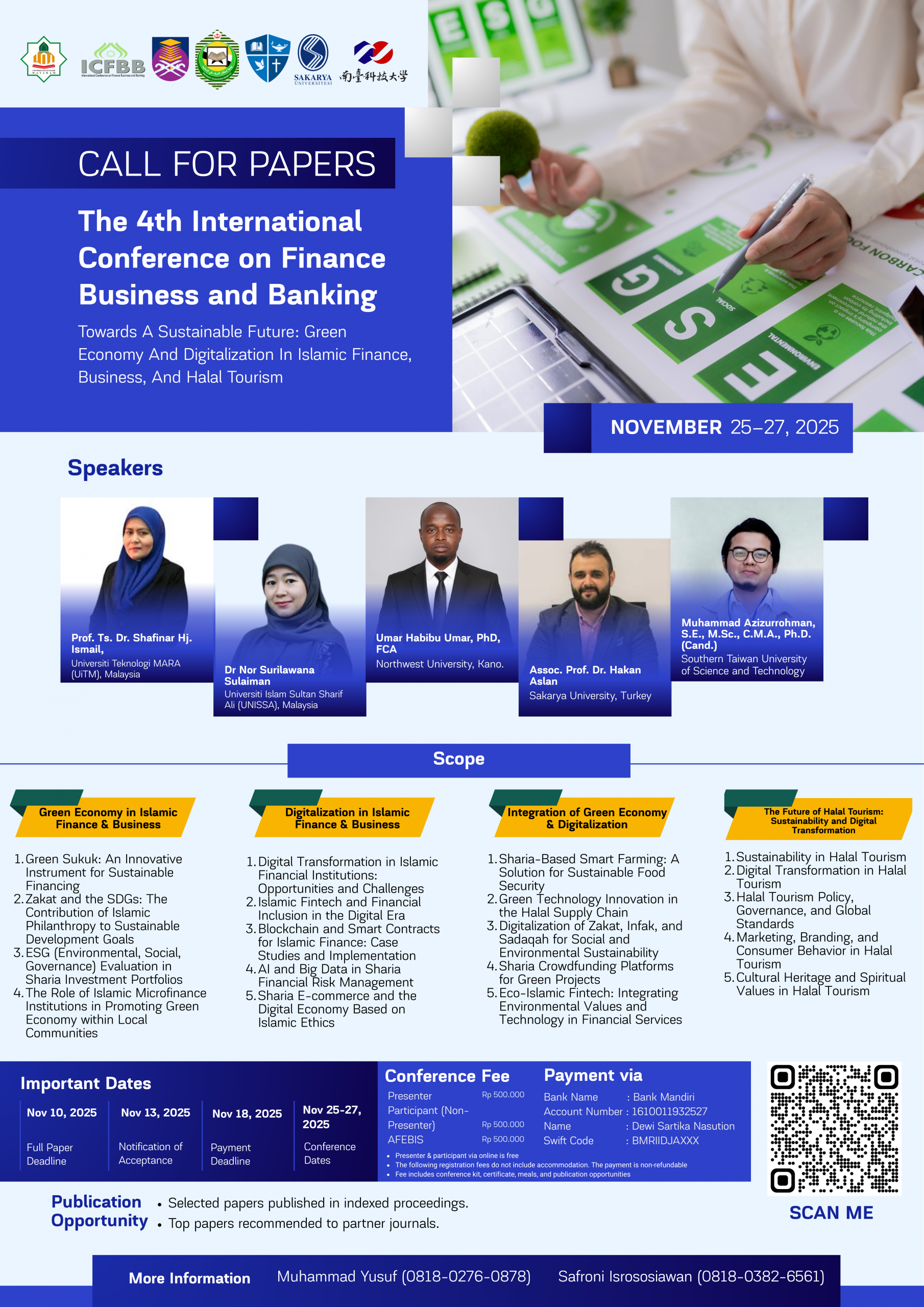
Strategies to Support the Implementation of Sustainable Development Goals (SDGs) Through Sharia Financial Technology: Potential and Challenges
Keywords:
Sustainable Development Goals (SDGs), Sharia Financial Technology, Sharia FinanceAbstract
Islamic finance, especially Islamic financial technology, in its development has shown great potential in supporting the implementation of the Sustainable Development Goals (SDGs) launched by the United Nations (UN) to protect human welfare and the environment. The presence of sharia fintech can increase people's financial inclusion, business development and income, as well as fulfillment for the economy. This research is qualitative using the study library research method with a literature review approach. This study aims to further review how the strategy of using sharia fintech in supporting the implementation of the SDGs is accompanied by its potential and challenges. Based on the results of the study, there are several strategies for using sharia fintech in supporting the implementation of the SDGs to overcome global problems, namely through poverty alleviation, quality education, gender equality, infrastructure innovation, and climate action. Some of the opportunities for the development of sharia fintech in Indonesia include the OJK providing opportunities for sharia fintech actors to freely register their businesses legally, the ease of technology for investment and donation activities, and the opportunity for sharia fintech to show its advantages due to fintech The majority of Indonesia's population is Muslim, and the rapid development of technology in Indonesia has the opportunity to be used quickly and more efficiently by the Muslim community. However, although the opportunities for the development of sharia fintech in Indonesia are quite promising, based on the facts that occur in the field of sharia fintech, several challenges are still faced, including: 1) Lack of public literacy and knowledge of sharia financial services, 2) Government regulations, 3) Lack of religious awareness, 4) Lack of human resources who understand and understand the rules related to the sharia economy, 5) Green project risk management, 6) Technology gaps, and 7) Lack of data security.
Downloads