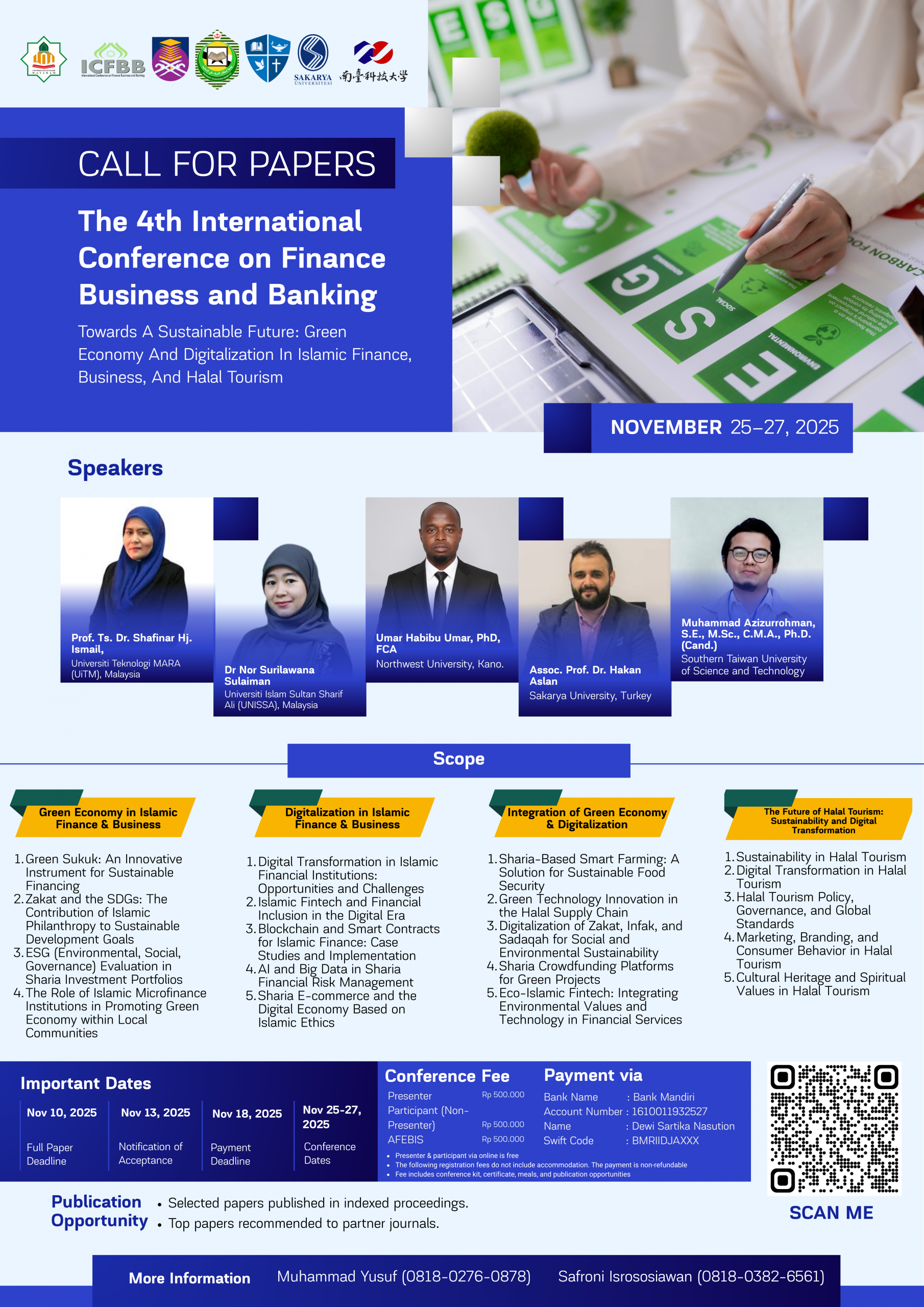
Islamic Fintech as a Catalyst for Green Economic Transformation: A Deep Dive into Zakat-Based Funding Models in Bengkulu
Keywords:
Islamic fintech, Green Economy, zakat management, Digital Transformation, sustainable developmentAbstract
This study aims to examine the role of Islamic fintech in optimizing zakat collection and distribution to advance green economic transformation in the Bengkulu region, while identifying the opportunities, challenges, and impact potential of integrating zakat-based funding with digital Sharia-compliant platforms. Using a qualitative case study approach, the research synthesizes documentary analysis of national policies (e.g., BAZNAS’s Green Zakat Framework), institutional reports, and field-level operational data from Bengkulu’s zakat bodies, Islamic financial institutions, and green investment initiatives (e.g., the Hello Green Nusantara PT Bengkulu Mandiri partnership). The results indicate that Islamic fintech offers transformative opportunities particularly through blockchainenabled transparency, AI-driven targeting, and crowdfunding scalability to channel zakat toward productive green projects such as mini-hydro power and circular economy enterprises. However, major challenges persist, including fragmented regulation, weak monitoring and mentoring capacity at the local zakat management level, low digital and financial literacy, and eroded public trust due to governance failures. The study’s novelty lies in its granular, regionally grounded analysis that bridges macro-level national strategy with micro-level operational realities, proposing a hybrid implementation model where trusted zakat institutions partner with specialized fintech providers to overcome capacity gaps. This work contributes a practical, context-sensitive roadmap for policymakers and Islamic finance practitioners seeking to mobilize zakat as a scalable instrument for sustainable and inclusive development.
Downloads